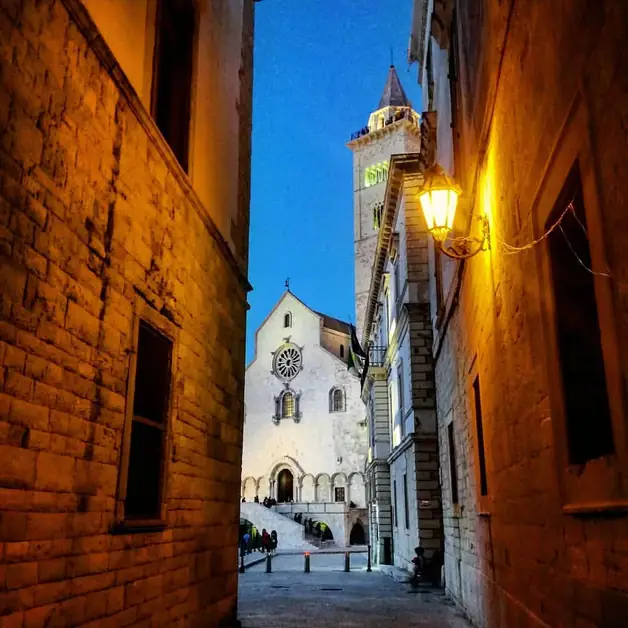
Complete guide to Trani's ZTL for tourists
Find out everything about Trani's ZTL to plan your trip.
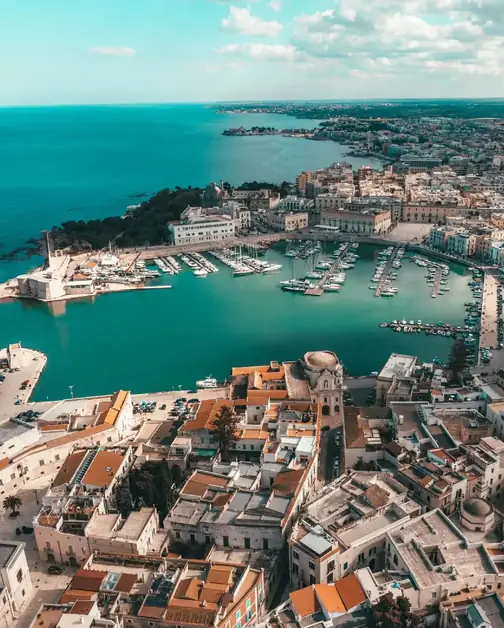
When you arrive in Trani, the temptation is immediate: the port, the seafront, a quick stop, then walking among boats and light stone. But that "quick stop" can catch you off guard. The city isn't mean, but it has very efficient cameras. The ZTL here isn't abstract; it's a real boundary with electronic gates, movable barriers, and seasonal hours.
The good news? Once you understand the zones and control times, Trani becomes simple. Park outside the sensitive area, walk in, and enjoy the best parts—the compact historic center and the always scenic port, especially in the evening.
ZTL in Trani: What Changes for Drivers
ZTL means Limited Traffic Zone: some streets are "filtered" by time and permits. In Trani, the idea is to protect three delicate areas: the historic center (narrow alleys, many homes and pedestrians), the port area (where summer evening crowds are huge), and the via Mario Pagano area (an urban hub that clogs quickly if left open).
If you're visiting for the day, change your mindset: don't think "park right at the restaurant," but "park nearby, walk." And in Trani, walking is a pleasure. You'll find sea views, sudden open squares, and that special glow from the local stone during golden hours. Curious why the city "shines" like this? There's a detailed read worth checking out: Trani stone and its use in construction.
The Three Areas: Permanent, Port, and Via Pagano
Trani's ZTLs are three, best remembered as three different "rings."
The permanent ZTL is in the historic center and doesn't change year-round. It includes: via Zanardelli, via San Giorgio, vico Corte Canina, via Nigretti, vico Ciardi. Here, cars are almost always a problem without permits: narrow streets, controlled passages, and movable barriers.
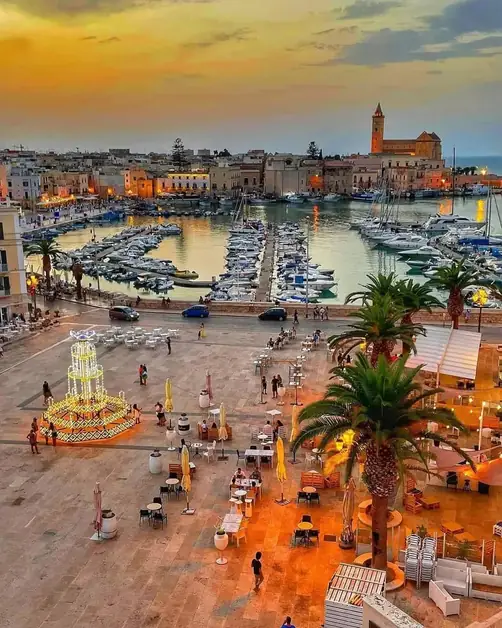
The port ZTL is trickier for outsiders because it covers the most desired parts: the port and seafront. Included streets are: via Statuti Marittimi (from piazza Tiepolo to via Banchina al Porto), via Banchina al Porto (from via Statuti Marittimi to piazza Sedile San Marco), then via Bellini, via Rossini, via Santa Maria, piazza Teatro, via Mercadante, via Fabiano. Translation: if your GPS leads you "toward the port," you're heading to the most controlled spot.
The via Pagano ZTL includes via Mario Pagano, via Casale, piazza Libertà, and surrounding streets. It's often underestimated because it doesn't "sound touristy" like the port, but many pass through here to cross the city.
ZTL Hours 2025: When Controls Start
Hours are crucial because they change habits: in Trani, there's no "always open" for all zones.
The permanent ZTL is active every day in two slots: 11:00–00:00 and 00:00–08:00. In between, there's the 08:00–11:00 window, mainly for those with specific permits (residents, loading-unloading, documented needs).
The port ZTL is seasonal and follows this schedule:
- June 16 – September 15: daily 20:00 – 02:00
- September 16 – October 31: pre-holidays 18:00 – 01:00, holidays 10:00 – 24:00
- November 1 – February 28: suspended
- March 1 – June 15: pre-holidays 18:00 – 01:00, holidays 10:00 – 24:00
The via Pagano ZTL is the most "strict": active every day, 24 hours.
If you want precise checks when planning a weekend (especially between June and October), find a municipal update on hours here: ZTL – hours effective from September 16, 2025 (Comune di Trani).
Gates and Barriers: Where They Really "Catch" You
Control isn't theoretical: ZTL access is managed through six electronic gates, located at:
- intersection via Statuti Marittimi / piazza Tiepolo
- intersection via Banchina al Porto / piazza Sedile San Marco
- intersection via Mario Pagano at the corner with via Annunziata
- intersection via Mario Pagano at the corner with piazza della Repubblica
- intersection via Edoardo Fusco / via Giovanni Bovio
- intersection via Baldassarre / via Giovanni Bovio
Completing the system are four stations with automatic bollards (the pilomat) that often act as a "mental traffic light" for drivers:
- via Zanardelli (side piazza Libertà and side via Statuti Marittimi)
- via Rossini (entrance piazza Teatro)
- via Fabiano (entrance from via Statuti Marittimi)
- via San Giorgio (entrance via Mario Pagano and piazza del Plebiscito)
The point is simple: even if it "looks like a normal road," if you're near these intersections, you're already in the red zone. So, the smartest move is to choose parking first and get there without letting the navigator drag you towards the port. If you need practical advice to plan (with a "arrive, park, walk" logic), here's a complete guide: complete parking guide in Trani, Puglia.
Permits and exemptions: residents, disabled, hotels, and loading/unloading
The ZTL isn't a "total ban," but a regulated access. There are clear rules for specific categories and situations.
Allowed vehicles: the transit ban applies to all types of vehicles: even mopeds and motorcycles can't enter unless expressly authorized.
Residents: besides legally provided categories, residents can also be authorized, but with access limited to the 08:00–11:00 interval.
Loading and unloading goods: vehicles for transporting goods with a mass under 35 quintals can enter the first ZTL (via Zanardelli, via San Giorgio, vico Corte Canina, via Nigretti, vico Ciardi) only from 08:00 to 11:00. Parking is allowed for a maximum of 15 minutes: just enough time for delivery and departure, not for "doing a couple of things and coming back."
Disability: those with a disability badge can access and park, but must communicate vehicle details to the Local Police via fax 0883 500249 or email comando.pm@comune.trani.bt.it. It's one of those details that seems bureaucratic until it becomes crucial.
Hotel, guesthouse, or retirement home clients: access in the two ZTLs (permanent and port) is allowed exclusively for luggage loading/unloading or vehicle pickup and return. The 15-minute rule applies here too, and the structure's ID badge must be displayed. Additionally, the structure must communicate vehicle details within 24 hours (same contacts: fax 0883 500249 or email comando.pm@comune.trani.bt.it).
Temporary permits: the Municipal Police Command can evaluate requests and grant temporary exemptions for justified reasons.
Finally, the part many underestimate: if you enter without authorization, generally the fine arrives. The chances to "rectify" the situation are mainly linked to hotel and disability access cases, provided the data communication is done correctly. For those who want to read the regulatory framework at the source (useful as a reference document), here's an ordinance in PDF: ZTL Ordinance (PDF Comune di Trani).
My strategy to avoid mistakes
Once I arrived in Trani on a July evening with that typical confidence of "it's just a small city." It was 19:35, the air was warm but not muggy—I'd say around 29°C—and from the window came the salty smell of the port mixed with a fried aroma that makes you hungry even if you've just had a snack. The navigator, without hesitation, led me towards via Statuti Marittimi: it seemed the most logical thing, "port = parking near the port."
Then I saw the ZTL sign, and immediately after, a clear feeling of about to make a mistake: not a vague doubt, but that gut punch of "if I pass here, tomorrow I'll get a surprise." I slowed down, made a maneuver longer than expected (with some unfriendly looks from other drivers), and stopped for a minute to get organized. The problem wasn't Trani: it was me using the navigator as if it were a pass to enter anywhere.
Since then, I always do this: first I choose where to leave the car, then I set that point as the destination. If I arrive near the port at a "borderline" time (like between 19:30 and 20:00 in summer), I consider the port ZTL as already "active in my mind" and don't risk it. Result: I walk 10–15 minutes, yes, but I start well—no U-turns, no anxiety, and no mental energy burned behind signs. And the paradox is that this walking part becomes the start of the visit: sound of rigging, lights on tables, and the city slowly envelops you instead of being "driven through" by car.
Mistakes to avoid in Trani's ZTL
🚫 Relying on the navigator to the port. If you type "Trani port" as the destination, you're often heading straight to the gates. Better to choose a parking area first and get there.
🚫 Thinking evenings are freer. Actually, in summer it's the opposite: the port ZTL activates in the evening hours (20:00–02:00 from June 16 to September 15).
🚫 Confusing access with parking. Hotels and loading/unloading aren't "permissions to stay": the 15 minutes is a concrete rule, not a flexible guideline.
🚫 Forgetting to communicate the license plate. For disabled and accommodation facilities, communication (fax/email) is part of the procedure: if missing, "but I had the right" becomes hard to prove.
🚫 Believing scooters and mopeds are excluded from the ban. In Trani, the ban applies to all vehicle types: without authorization, you can't pass.
🚫 Ignoring the automatic bollards. If you find the pilomat on Zanardelli, Rossini, Fabiano, or San Giorgio, they're not decoration: they're part of the control system.
In practice: the ZTL in Trani doesn't ruin your visit, it just forces you to make the smartest choice. Park wisely, enter on foot, and use the times as a guide. The city works much better this way—for you and for those who live there.
Ready to experience Trani without stress (and with some nice detours)?
🗺️ Vasca di Boccadoro: nature and history near Trani
🌿 Ariscianne–Boccadoro wetland: a different walk
✈️ Best cities to visit in a day from Bari
🏨 Where to stay in Puglia: practical choices