Tavole Palatine: what they are, how to get there, and how much time you need to visit them
A Greek Doric temple from the 6th century BC in the middle of the Ionian plain, a few kilometers from the sea. Free entrance, free parking, visit in 30 minutes. But there is one thing you don't expect when you arrive.
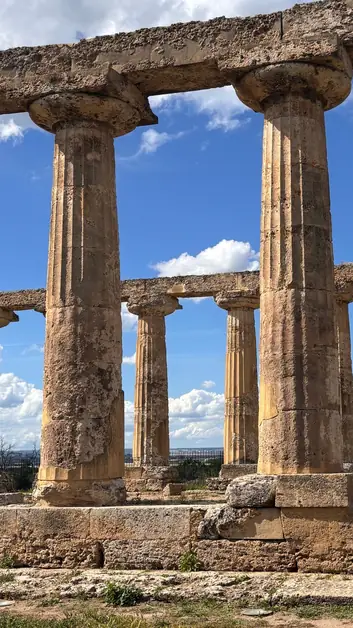
I think the Tavole Palatine are worth visiting mainly for their location.
You have the Bradano River nearby, the Salinella Lake not far, a coast with dunes and pine forest, and one of the most beautiful stretches of the Ionian Sea.
Amidst this landscape, almost suddenly, the columns of the Greek temple appear.
When you usually see an ancient monument in a city, it's harder to imagine the original landscape around it. Here, it's almost the opposite.
Here, you can still imagine quite well the landscape that surrounded the temple thousands of years ago: the river, the sea not far, the open plain, and the Ionian coast's vegetation. Amidst all this natural beauty, the Greeks built a structure meant for the soul.
For years, I passed by while going to Taranto, without really noticing it. Even though the site is near the SS106 Ionian highway, the columns aren't obvious from the road unless you know where to look or stop.
When you finally arrive, you walk down a small tree-lined avenue, and then the columns appear, isolated in the plain and almost out of place in the area's agricultural landscape.
The Tavole Palatine are the remains of an ancient Doric Greek temple dedicated to the goddess Hera, built in the 6th century BC in the Magna Graecia area, near ancient Metaponto.
Today, mainly 15 Doric columns remain standing from the temple. Although the original complex was much larger, these columns have become one of Basilicata's archaeological symbols.
The name Tavole Palatine doesn't come from the Greek period but from traditions and interpretations born many centuries later. In the past, the monument was also associated with Charlemagne's paladin knights, hence the current name.
The temple was dedicated to Hera, one of the main deities of the Greek world, often linked to marriage and fertility.
Where they are and how to get there
The Tavole Palatine are near Metaponto, in Basilicata. They're in the plain of the Ionian coast, not far from the Bradano River.
The site is along the SS106 Ionian road, a main road in the area. You can easily reach it by car from Matera or the coastal resorts.
Entry to the site is free, and there's a large free parking area. So, parking near the archaeological area is usually easy.
However, there are no restrooms, so plan ahead before visiting.
How to visit and how long it takes
Visiting the Tavole Palatine is quite short. It realistically takes about 20 to 40 minutes.
Don't expect a large, complex site like Paestum. Here, the experience is quicker, focusing on the landscape's impact.
On sunny days, the contrast between the light columns, the sky, and the surrounding plain makes the site even more scenic.
Usually, visitors to the Tavole Palatine continue to the archaeological park and museum of Metaponto. Or they head directly to the Ionian coast beaches. Being just 30 minutes from Matera, it's often part of a day trip combining sea, archaeology, and Basilicata's Ionian landscapes.
Because the site's visual impact is still strong, some maintenance and enhancement issues are noticeable right away.
Visiting the Tavole Palatine, I felt the place could be much better showcased.
I found an unkempt green area, intrusive construction nets around some excavation zones, and a general sense of limited area control.
This is striking because, for years, the site was a backdrop for wedding and photo shoots. Many couples came for the stunning view of the columns in the plain. Today, that scenic potential remains, but the site seems less appreciated than it could be.