The Parish of San Giovanni Battista in Matera to visit
The Parish of San Giovanni Battista is an architectural jewel in Matera, rich in history and art, that must be visited.
What is the Parish of San Giovanni Battista in Matera and why is it important to visit?
The Parish of San Giovanni Battista is a parish church located in Matera, known for being one of the architectural jewels of the city. This church, built in Apulian Romanesque style, represents an example of refined medieval architecture and is a place rich in history and art that every tourist should discover during their visit to Matera.
What is the ancient history of the church of San Giovanni Battista in Matera?
Originally, the church was known by the name of “Santa Maria La Nova” and was dedicated to the nine penitent nuns of Accon, who arrived in Matera from Palestine before 1193 thanks to Bishop Andrea. In the past, it was also called “Santa Maria ai Foggiali,” a name linked to the Latin “Fovea” meaning “pit,” referring to the characteristic of the territory rich in cavities used to preserve foodstuffs such as cereals and legumes.
When was the church built and what historical events influenced its life?
The church of San Giovanni Battista was the first sacred building to rise outside the walls of Matera and was completed in 1233. However, during the Otranto war in 1480, the church was abandoned because its isolated position outside the defensive walls made it dangerous for the nuns who lived there. Only in 1695 was the church reopened for worship with its current name, but due to the long period of abandonment, significant structural interventions were necessary.
What are the most interesting architectural features of the church of San Giovanni Battista?
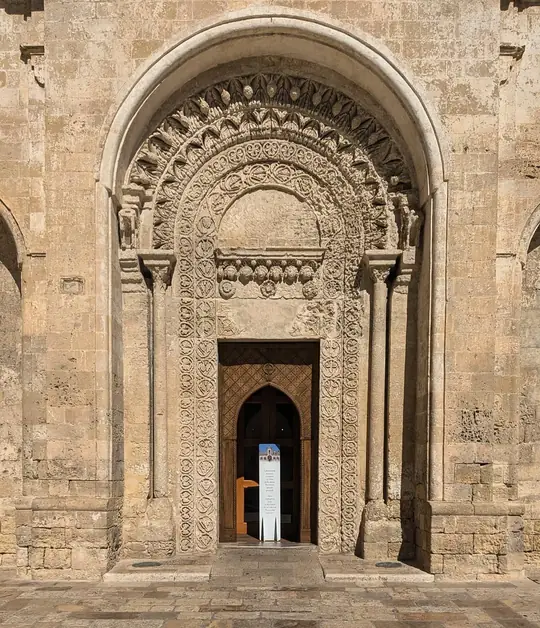
Despite some structural modifications, the church retains elements of great elegance and artistic value. For example, the central portal, made by the master stonecutters Michele Del Giudice and Marco Di Lauria, is finely carved with vegetal motifs and sculpted heads, recalling the style of the lion's gate of the cathedral of Matera.
What can be admired in the upper part of the facade?
At the center of the tympanum is a small rose window surrounded by hanging columns and pilasters, decorated with particular zoomorphic sculptures. Below the rose window stands a polychrome statue in stone of San Giovanni Battista holding the Gospel with a lamb, a very significant religious symbol.
What are the characteristics of the apse and what makes this side of the church unique?
The exterior of the apse, visible to the right when looking at the portal, is the part that has undergone the least modifications over time. At the top of the tympanum is a sculpted angel watching over the church. Lower down, a large semicircular arch is accompanied by brackets topped with elephants, while a monofora niche window, with colored glass, illuminates the interior. Around this opening are columns with zoomorphic figures, whose details refer to the Romanesque style of the portal.
How is the interior of the church of San Giovanni Battista organized?
Inside, the church maintains a medieval atmosphere thanks to the restoration carried out in 1926 by Abbot Marcello Morelli, who removed the eighteenth-century stuccos revealing the sober original limestone. The plan is Latin cross-shaped and features three naves divided by quadrilobate pillars with attached semi-columns.
What are the most important decorations inside the church?
Each pillar is crowned by a unique capital, with anthropomorphic, zoomorphic, and vegetal motifs rich in medieval symbolism. These capitals support large transverse arches that form ribbed vaults, creating a suggestive environment rich in history.
What works of art can be seen in the left nave of the church?
The first chapel on the left nave houses a 16th-century fresco entitled “Madonna delle Nove.” Above the altar is a sculptural group from the workshop of Altobello Persio depicting the Annunciation and God the Father with the sphere symbolizing humanity.
Which saints are represented in the next chapel and what is their importance?
The second chapel is dedicated to the medical saints Cosimo and Damiano, Christian martyrs. Here are two wooden statues dressed in the characteristic red and green cloaks, which are carried in procession every year. Additionally, on the altar, there is an 18th-century canvas by Vito Antonio Conversi depicting the Virgin in glory surrounded by various saints.
What other notable works of art are in the church?
Continuing along the left nave, one can admire a polychrome wooden sculpture from the 17th century, the “Pietà,” created by the Materan sculptor Pasquale Calabrese. In the same nave, near the confessional, there is a historical graffito commemorating the murder of Count Tramontano in 1514.
What does the baptismal font sculpture represent and where is it located?
The baptismal font is a recent sculpture, made in 1929 by Ercole Raduzzi. Inside the nave, there is also a 16th-century statue in tuff of San Giovanni, coming from the Materan school, which was once placed on the main altar. This statue is very similar to the one on the facade, with San Giovanni holding the Gospel on which a lamb is crouched, symbol of the saint.
Where is the Parish of San Giovanni Battista in Matera located?
The church is located on Via San Biagio, in the historic center of Matera. This position makes it easily reachable during a walk in the city of Sassi, allowing visitors to admire an important example of Romanesque architecture and discover a piece of Matera's religious and cultural history.
What are the Mass times at the Parish of San Giovanni Battista?
The parish celebrates Mass all year round. On weekdays, Mass is held at 7:00 PM, while on holidays there are three celebrations: early in the morning at 8:00 AM, then at 11:30 AM and finally at 7:00 PM. These times allow both local faithful and tourists to participate in moments of prayer.
How can one experience an authentic visit to the Parish of San Giovanni Battista?
Visiting this church means immersing oneself in a medieval atmosphere rich in artistic and historical details. Observing the hand-carved capitals, admiring the works of art, and discovering the stories related to the saints and historical figures that the church preserves makes the visit a unique and engaging experience.
Why is the Parish of San Giovanni Battista a must-see for tourists in Matera?
The church represents not only an important place of worship but also a monument rich in history and art. Its well-preserved Romanesque style, sculptures, frescoes, and traditions related to the saints make it a perfect destination for those who want to know the cultural and spiritual heart of Matera. Furthermore, its central location allows visitors to combine it with other tourist itineraries in the city.