Piazza Sant'Oronzo in Lecce rich of history and beauty
Piazza Sant'Oronzo is the heart of Lecce, rich in history and beauty.
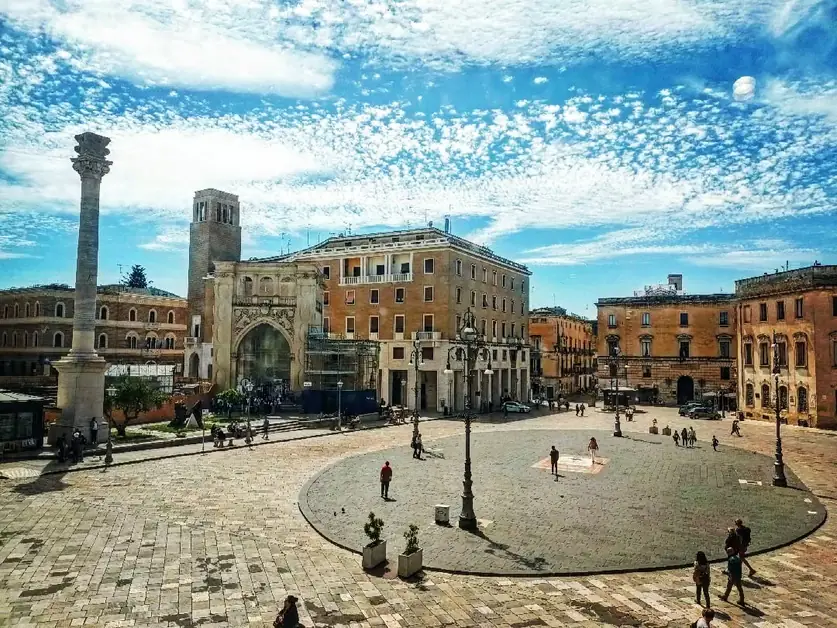
Few cities identify with a square like Lecce does. Piazza Sant'Oronzo isn't just "the center": for locals, it's the place to meet, pass by, or enjoy concerts and shows. All under the watchful eye of Saint Oronzo, up on the column, observing city life for over three centuries.
The most surprising thing is the scenic effect: in Lecce's historic center, you often lack wide views. You walk through alleys and curves, and monuments appear "by surprise" around corners. Here, the space opens up: a wider, more "modern" square with important buildings framing it.
Why Piazza Sant'Oronzo "stands out" from the historic center
In many parts of ancient Lecce, you're forced to look closely: stone, details, sudden shadows. Piazza Sant'Oronzo changes the rules. Around its perimeter, prestigious buildings and public palaces (like the Church of Santa Maria delle Grazie, the Palazzo dei Tribunali, the Palazzo di Città) mix with 19th-century and more contemporary architecture.
The result is a square designed for happenings: no wonder it's a natural spot for events and entertainment. Arrive at sunset, when stones warm with light and people gather at tables, and you'll see why locals use it as a "living room."
From "Piazza dei Mercanti" to the amphitheater: the square that changed
This space was once called "Piazza dei Mercanti". Imagine it cozier, with a different urban layout: curving blocks, almost medieval, spiraling around the space. Today, that design is gone.
The point is, beneath it, a giant lay hidden for centuries. Enigmatic wall blocks poked through the asphalt for a long time: locals knew (or suspected) something huge was underneath. A fascinating rumor even circulated: tunnels led to ancient Rudiae.
In the early 1900s, systematic archaeological investigations began. But it was later, with urban pushes and a desire to "showcase" Roman Lecce, that the square changed shape and orientation. In 1938, a rapid demolition phase occurred: important historical traces vanished, and the amphitheater was finally "freed" and highlighted.
Today, that contrast is the place's signature: a 20th-century square showcasing a Roman monument as if it was always there.
What to see in the square (even if you have only 20 minutes)
If you're short on time, view Piazza Sant'Oronzo as a collection of "fixed points," all very close.
The Roman amphitheater is first. Even without entering, pause a minute and follow the curve of the steps to imagine the crowd's noise and shows from two thousand years ago. If you want to include it in a broader itinerary, the center has many walkable stops: this article helps you explore Lecce's historic center without missing key spots.
Then there's the Sedile (or Seggio), surviving major changes: compact, recognizable, photogenic. Next to it, another "miracle" of urban history: the Church of San Marco, small but significant in showing what remained standing as everything around changed.
Finally, the column with Saint Oronzo: the symbol uniting devotion and city identity.
Details almost everyone misses: mosaic, superstition, and the Clock of Wonders
There's a spot in the square often overlooked because it's... underfoot. On the oval, find a mosaic with the city's emblem: the wolf under the holm oak. Popular tradition says don't step on it: for superstition, many avoid it without thinking, like an automatic gesture. It's one of those details making the visit more "real" because it shows you the square as locals experience it daily.
Then look up at another symbol, this time on the facade: the Clock of Wonders, in Art Nouveau style. It's a grand, decorative object full of details and symbols: said to weigh about 20 quintals, stand 10 meters tall, and made of 52 bronze castings. A recent restoration highlighted its ornamental details better.
And here's the best anecdote, because it's auditory: locals are used to bells and chimes, but at noon in the square, you might hear special music linked to Tito Schipa, the great tenor from Lecce. If you're there at that time, pause a moment: it's one of those things you can't photograph, but it stays with you.
Practical information: how to reach Piazza Sant'Oronzo and if you can drive there
This is the part that really makes the difference between a relaxed visit and a stressful day.
On Foot (the simplest solution)
If you arrive by train, Piazza Sant'Oronzo is a comfortable walk away: it takes about 15-25 minutes, depending on your stops (spoiler: you'll stop). For an easy route with practical tips, start with this guide: practical information about Lecce station for travelers.
By Car: Yes, but not "to the square"
Piazza Sant'Oronzo is in the heart of the center, so plan your car use wisely:
- The best idea is to park outside and walk in;
- Watch out for ZTL and access points, which vary by time and day.
To avoid improvising (and the classic "I didn't notice" fine), read this guide first: ZTL guide for tourists in Lecce.
For official info on the latest hours and rules, here's the institutional reference (the only external link I'll leave):
Where to Park (Without Going Crazy)
If you're traveling by car, aim for external parking and then walk in. For a concrete list of useful options (even if you want to save money), I recommend: the best free parking in Lecce for tourists.
If You Arrive from Brindisi Airport
Many come from Brindisi and then reach Lecce: to choose between shuttle, train, or rental car without wasting time, follow this practical guide to reach Lecce from Brindisi airport.
Mistakes to Avoid in Piazza Sant'Oronzo
🚫 Entering the center by car "on a whim"
The ZTL is not the place to improvise: check hours and access points first, and don't rely only on your GPS.
🚫 Thinking a photo of the amphitheater is enough
The square is full of details: the Sedile, San Marco, the arcades, the clock, the mosaic underfoot. If you don't do the full tour, you'll miss half of it.
🚫 Stepping on the Lupa mosaic without noticing
Whether you're superstitious or not, it's a symbol locals respect: look at it, photograph it... and then walk around it with a smile.
🚫 Coming at noon in August without water
It seems obvious, but between the sun and light stone, energy drops quickly. A water bottle saves your mood.
🚫 Not having a backup parking plan
If an area is full, don't waste half an hour circling: choose an alternative and walk in. The center is better enjoyed this way.
How Much Time to Spend and How to Fit It in an Itinerary
Piazza Sant'Oronzo "consumes" in a strange way: you can cross it in 5 minutes, but to really experience it, give it at least 45-60 minutes for a full tour, photos, details, and a break.
If you have half a day in Lecce, the most natural flow is: Piazza Sant'Oronzo → alleys and baroque → evening closure in another scenic square. The nice thing is that Piazza Sant'Oronzo works as a starting point: from here, Lecce opens up like a fan, and you choose based on your energy at the moment.
Want to continue the tour without wasting time (and without stress)?
🏛️ Explore Lecce's Roman amphitheater and its history
🌙 The magic of Piazza Duomo in Lecce at night
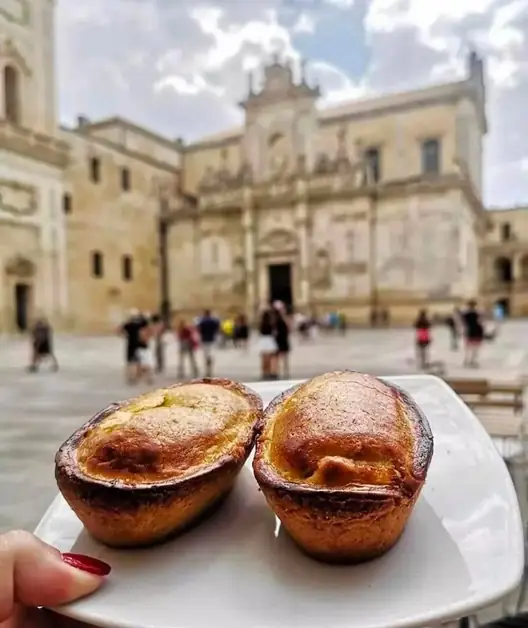
🥐 The secret of the pasticciotto leccese and where to taste it
If you tell me how you arrive (car / train / airport) and when (summer, weekend, patronal feast), I'll suggest the best combination of parking, timing, and walking route to enter the center with zero hassle.