Explore the Murgia Materana Park
The Murgia Materana Park is a treasure of history and nature in Basilicata, featuring unique rock landscapes and extraordinary cultural heritage.
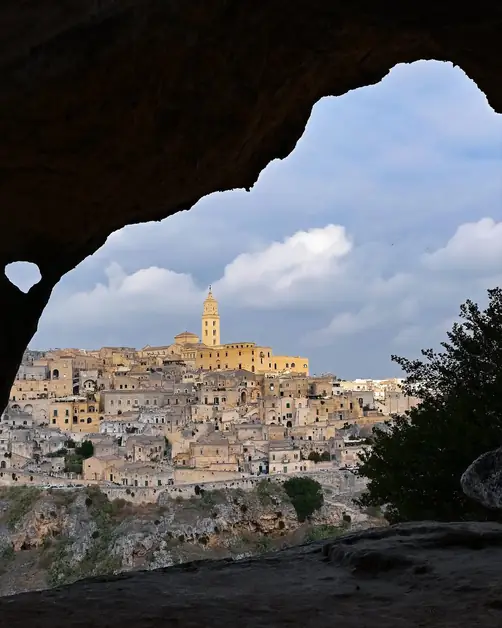
The Archaeological Historical Natural Regional Park of the Rupestrian Churches of Matera, simply known as the Murgia Materana Park, is one of the most spectacular rock landscapes in Italy. It is located in Basilicata, in the province of Matera, a few kilometers from the border with Puglia. This territory represents a perfect example of the ancient relationship between nature and man, evidenced by rocks, caves, and prehistoric settlements.
What characterizes the landscape of the Murgia Materana Park?
The Park is characterized by a soft and friable rock called calcarenite, which has been shaped over time by deep grooves, creating cliffs, gorges, caves, and ravines. These natural elements have been used by humans since prehistoric times for settlements and places of worship. The morphological characteristics of the territory are very particular: almost uninhabited rocky areas alternate with slopes covered by typical Mediterranean vegetation.
What are the main areas of the Murgia Materana Park?
The Park includes several areas such as Tufare, Murgecchia, Murgia Timone, Acito San Campo, Trasano Conca d'Aglio, Murgia Alvino, and many others. To the west of Matera, the perimeter of the Park extends along the Gravina di Picciano, a deep limestone canyon. The Gravina di Matera itself is a huge incision in the rock about twenty kilometers long, reaching under the town of Montescaglioso.
Why is the Gravina di Matera so important for the Park?
The Gravina di Matera is a unique natural element. It is a limestone canyon with vertical, unreachable walls and a stream that flows slowly at the bottom, carrying water towards the Bradano River. This seemingly desolate environment hides numerous natural riches and historical testimonies. The slopes of the Gravina are very different from each other: the eastern side is more complex due to the presence of the town of Matera and Montescaglioso, while the western side is almost uninhabited and covered by typical Mediterranean vegetation.
What traces of man are visible in the Murgia Materana Park?
On the western slope of the Gravina, there are rock churches carved into the rock, Neolithic villages, jazzi (animal enclosures), quarries from which stone was extracted to build the houses of the Sassi of Matera, and ancient farmhouses. These sites are extraordinary examples of how man has been able to coexist with the natural environment, using limestone rock to live and pray. Today, this area, about 8000 hectares, is protected within the Murgia Materana Park.
What is the role of the Management Authority of the Murgia Materana Park?
The Management Authority of the Park is responsible for protecting both the spectacular nature and the works created by man over the millennia. This protection work is essential to preserve the balance between the environment and cultural heritage, ensuring that the carvings and rock constructions remain intact for future generations.
What is the geological history of the Murgia Materana?
The geology of the Murgia Materana is very interesting. During the Pliocene and Pleistocene, there were tectonic subsidence and uplift that caused prolonged marine sedimentation. This process formed a carbonate platform composed of two main rock layers: the Calcare di Altamura, a very thick and ancient lower layer, and the Calcarenite di Gravina, a more friable and granular upper layer. It is this calcarenite that has favored human presence, as it is an easy rock to excavate and shape.
How were the caves and rock churches formed?
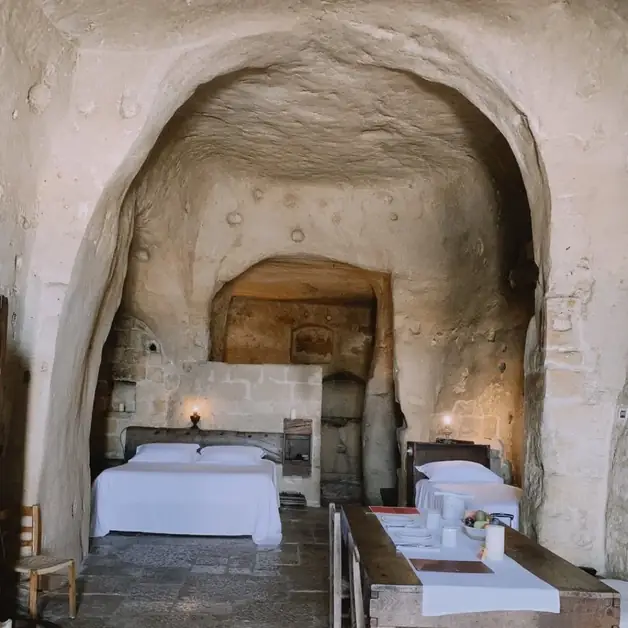
Natural caves were formed by the disintegration of calcarenite, which is a friable rock. Subsequently, humans widened these cavities with patient and precise excavation techniques. Thanks to this work, rooms, windows, shelves, and even rock churches were born, representing a historical and artistic heritage of great value.
What watercourses cross the Murgia Materana Park?
Surface watercourses are few and modest due to the permeable and fissured nature of the limestone rock. The main one is the Gravina stream, which flows at the bottom of the eastern canyon of the same name, near the city of Matera. This stream is fed by the Jesce stream, which forms a natural pond called "Jurio" or "gorgo" in the local dialect. During intense but rare rains, water flows into the blades, that is, the small grooves of the minor gorges, and flows into the Gravina.
What animal species can be observed in the Murgia Materana Park?
The Park is a refuge for many rare bird species, especially raptors. Among these, it is possible to spot the biancone, the nibbio, the lanario, and the capovaccaio. Some raptors like the falco grillaio even live near human settlements, nesting under the roofs of abandoned houses in the Sassi of Matera or under the tiles of the Benedictine Abbey of Montescaglioso.
Why is the Murgia Materana Park an ideal place for bird-watching?
The presence of vertical rocky walls, rich Mediterranean vegetation, and the absence of human settlements in some areas create perfect natural environments for wildlife, especially for raptors and rare bird species. Bird-watching enthusiasts can enjoy unique observations in a very picturesque and undisturbed landscape.
What are the characteristics of the vegetation of the Murgia Materana?
The vegetation in the western area of the Gravina is typically Mediterranean, with shrubs and plants adapted to the rocky climate and soil. In the part closest to Matera, the limestone rock is often devoid of tree vegetation, but moving inward, there are Mediterranean forests that represent the last remnants of this natural environment in the area.
How do nature and history intertwine in the Murgia Materana Park?
The Murgia Materana is a place where nature has shaped the landscape, creating ideal environments for human life since prehistoric times. Natural caves have become shelters and places of worship, rocks have been transformed into homes and farmhouses, and vegetation has provided resources for survival. This fusion of natural environment and human intervention makes the Park a unique site in Italy, where it is possible to admire history through geology, archaeology, and biodiversity.
What itineraries can be followed to visit the Murgia Materana Park?
The Park offers numerous trails that allow you to explore the ravines, rock churches, prehistoric villages, and wooded areas. Some paths follow the course of the Gravina stream, offering breathtaking views of the canyon and the city of Matera. Other itineraries delve into the Mediterranean vegetation, where it is possible to discover local flora and fauna. Each route is an opportunity to immerse yourself in the nature and history of an extraordinary territory.
What are the most important historical testimonies in the Murgia Materana Park?
In addition to the rock churches, the Park preserves prehistoric villages dating back to the Neolithic era, ancient stone quarries, and traditional farmhouses. These sites tell the story of a millennial relationship between man and the environment, made of respect, adaptation, and creativity. Visiting these places allows one to understand how ancient communities managed to live in harmony with a seemingly difficult territory, transforming it into a home.
How can you reach the Murgia Materana Park?
The Park is easily accessible from the city of Matera, which is an ideal starting point to explore its beauties. The state and provincial roads that cross the area connect the various districts and allow access to the most important trails. Visiting the Murgia Materana Park means discovering a hidden corner of nature and history just a few steps away from one of the most fascinating cities in Southern Italy.