Discover the Temple of Brindisi
Discover the Temple of San Giovanni al Sepolcro, a fascinating and mysterious place in the heart of Brindisi.
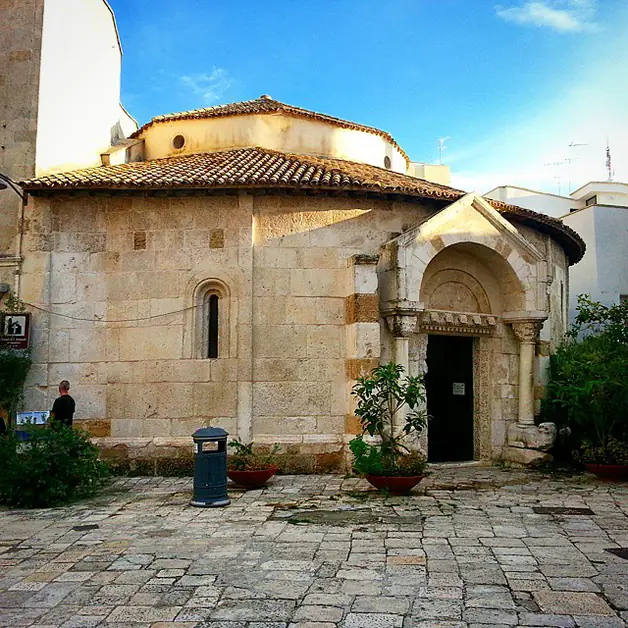
After enjoying Brindisi's sea, seaside walks, and evenings by the port, I decided to explore its historical side. Brindisi isn't just about urban beaches and nightlife. The historic center has places that tell stories of pilgrimages, trade, and connections with the East. The Temple of San Giovanni al Sepolcro is one of these. From the outside, it seems small and almost modest. But once inside, you quickly realize its historical and symbolic importance in medieval Mediterranean.
Where it is
The temple is in Brindisi's historic center, on Via S. Giovanni al Sepolcro. It's about a 10-minute walk from the seafront and the Roman Columns. It's also roughly the same distance from the Brindisi Cathedral. Its location makes it easy to include in a city center walk.
How long the visit lasts
The visit is quite quick. To calmly see the interior, read the panels, and stroll in the small garden, about 30 minutes is enough.
Why Visit
When you enter, you immediately feel Brindisi's connection to the Holy Land during the Crusades. The church was built by the Canons Regular of the Holy Sepulchre before 1128. That's the year of the first document mentioning it. It was meant to symbolically recall Jerusalem. Later, it passed to the Knights of St. John of Jerusalem, the future Order of Malta. This followed the city's religious and political changes. After a long period of neglect, the city restored it in the 1800s, preserving and enhancing the monument.
The building mimics the structure of Jerusalem's Rotunda of the Holy Sepulchre. In the Middle Ages, it was seen as a symbolic center of the Christian world. For those who couldn't reach the Holy Land, visiting places like this was a symbolic pilgrimage.
The first thing you notice inside is the space's shape. The floor plan is circular. In the center, eight columns support a series of round arches. This creates a unique, unexpected environment compared to the outside. Looking closely, you see the columns aren't identical. They vary in materials, proportions, and capitals, showing centuries of reuse. The current roof isn't original; it's from 19th-century restorations.
The walls have frescoes from the 13th and 14th centuries. Some are still readable, others are very fragmented. But overall, they show the site's connection to Eastern Mediterranean religious culture. In several spots, you also see graffiti left by pilgrims and knights over the centuries. Just below the floor, visible through a circular opening in the church's center, are older archaeological remains. Nearby, Roman mosaics from an imperial-era domus have been found. This shows the area's importance long before the temple was built.
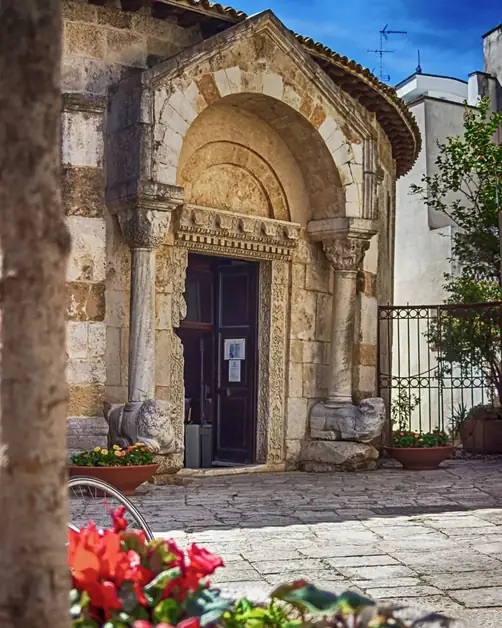
The portals are also worth noting. The main one features lion columns and carvings with plant motifs, human figures, and symbolic animals. The side portal has decorative elements with an Eastern style. A third entrance, now sealed, once led to the garden behind.
The visit costs 3 euros and includes the small external garden. Inside, there are several descriptive panels. They help you understand the building's structure, restorations, and historical layers. The garden, though small, is pleasant with citrus trees and flowers. Today, the monument is in a modern urban setting, surrounded by buildings that contrast with its ancient, intimate character.