Bari Liberty: Architectural Itinerary
Discover the Liberty itinerary in Bari, where elegance meets architectural history. Twelve must-see stops in the heart of the city.
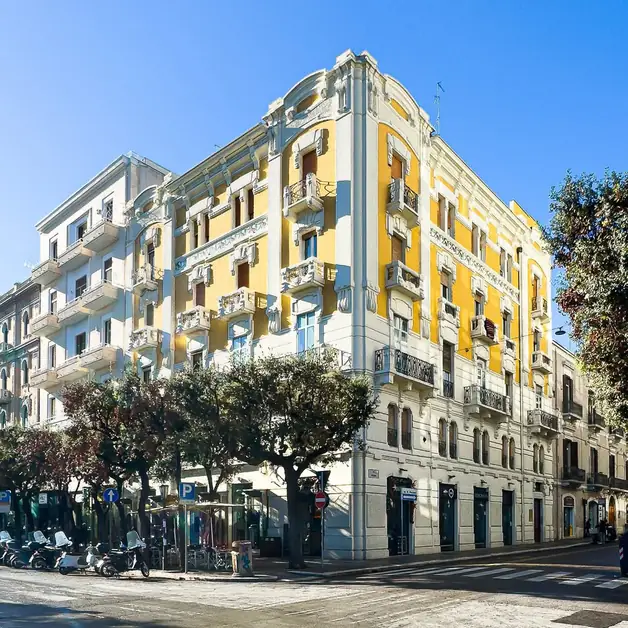
If you love architecture or discovering hidden city spots, Bari will surprise you. Besides the charm of Bari Vecchia and the monumental seafront, Bari has a rich Liberty heritage. It's often overlooked but worth a dedicated walk.
Before diving into the itinerary, let's step back a bit. The Liberty Style, known internationally as Art Nouveau, emerged between the late 1800s and early 1900s. It was a new architectural language for its time. It broke away from rigid past styles, introducing curves, floral motifs, natural elements, and refined decoration. Facades came alive with apotropaic masks, allegorical figures, sinuous wrought iron, and symbolic details, turning buildings into true artworks.
Bari embraced this trend, especially in neighborhoods developed between the late 1800s and early 1900s. But here's an urban planning note: most Liberty buildings aren't in old Bari, or Bari Vecchia. They're in the "new city," which expanded with the Murattian development from 1813. This area, between the port, seafront, and new roads like Corso Cavour and via Sparano, became an ideal lab for early 1900s architecture.
Liberty buildings are mainly in the Murattiano district, along the axis from the station to the sea, in the Madonnella district by the Araldo di Crollalanza seafront, and partly in the Libertà district. These areas, from the late 1800s to early 1900s, represented the city's modern expansion, not its original core. In 2019, Bari was named Best Liberty City of the Year by the Italia Liberty association, highlighting its architectural richness in these zones.
I must say, I'd been to Bari several times but never truly understood its architecture. I just strolled, admired facades, but lacked the tools to read them. Then, my wife suggested something different. We joined a group of local guides. This choice let us see the city with fresh eyes, noticing details we'd likely miss alone. The group works on a voluntary payment basis, no fixed fee, which I found interesting. It gives freedom to participants and makes the experience accessible to everyone.
One of the most iconic buildings is the Teatro Margherita. Built between 1912 and 1914 in the old port's curve, it marks a key moment in the city's building history. It's the first concrete building in Bari and the only European theater on stilts. Building it on the sea was part of a deal with the Petruzzelli family, who had the privilege to build theaters on municipal land. Today, the Margherita hosts exhibitions and cultural events, keeping its artistic spirit alive.
Not far away stands the Teatro Petruzzelli, opened in 1903. It's considered Italy's fourth largest theater. The facade is wide and dramatic, featuring balconies and niches. You'll see busts of Verdi, Rossini, and Bellini, allegorical figures, and a curved pediment with Apollo's statue. The Petruzzelli is a strong cultural symbol of the city. I've visited several times, even to hear Alessandro Barbero. It's beautiful inside and out.
In the Madonnella district, overlooking the Araldo di Crollalanza seafront, is the Teatro Kursaal Santalucia. It's a late Liberty style example. Used as a cinema and theater, it features bas-reliefs and frescoes by the Prayer brothers, Turin artists who moved to Bari in the early 1900s.
Continuing on Corso Cavour, next to the Petruzzelli, you'll find Palazzo Marroccoli. Today, it's the Hotel Oriente. Active since 1928, it retains refined exterior decorations fully embracing the Liberty style. Nearby are Palazzo Atti and Palazzo Stoppelli. They create a true early 20th-century architectural corridor.
Moving to via Sparano, in the heart of the Murattiano district, you'll see Palazzo Mincuzzi. Built between 1926 and 1928, it was the Mincuzzi family's commercial headquarters. The monumental facade and the interiors impress with a grand staircase and elegant decorations, capturing the era's elegance.
At the intersection of via Putignani and via Cairoli stands Palazzo Ingami Scalvini, built in 1923. The building is notable for esoteric and Masonic symbols and Latin inscriptions like "Per aspera ad astra" and "Faber est suae quisque fortunae." Nearby is Palazzo Chimienti, from 1921, also adorned with elegant decorations on portals and windows.
Finally, in the Libertà district, Palazzo Dioguardi is worth noting. It's recognizable by the lion's head above the door. There's also Palazzo Colonna De Robertis, dating back to the late 1800s. In an often overlooked area, you'll find genuine Liberty gems. They testify to a period of great artistic activity and a Bari engaging with European trends of its time.