Adventure at Bivacco Pasqualetti at 3290 meters
Experience the thrill of an adventure at Bivacco Pasqualetti at 3290 meters.
I've often experienced the Aosta Valley by choosing comforts: comfy hotels, easy roads, and warm evenings after a day outside. Yet, something has been intriguing me for a while. The idea of a challenge, simple but real, far from my usual habits. Or at least, the habits I've had since getting married 😅.
I want to train with a clear goal, prepare calmly, and one day attempt to reach Bivacco Pasqualetti.
Just so you know, it's located here:
I see many photos on Instagram: simple images that evoke more feelings than words. Looking at them, I try to imagine what it's like to accept such a challenge: the climb's effort, the backpack's weight, the isolation, and the total freedom.
I'm doing a lot of research, but secretly from my wife. I'm pretty sure she wouldn't agree with such a challenge--especially at my age.
The bivouac is on the Morion ridge, at 3290 meters, in Valpelline. It's for true climbers, those seeking forgotten routes and serious challenges. The ridge divides the Ollomont Valley from Bionaz and is a series of spires and exposed paths between 3000 and 3500 meters. It's not an everyday thing.
It takes about 5-6 hours to get there from the Crête Sèche refuge or the Regondi bivouac. The route is rated AD+/D-, with glacier, mixed, and rock sections. It's no walk in the park: good rock sections alternate with unstable terrain, always with significant exposure. Reading this makes my legs shake a bit, but also makes me want to try it.
What struck me most is the story behind the bivouac. It was born from local alpine guides' initiative. They wanted to bring attention back to forgotten routes. The Morion chain has extraordinary paths. Like the long traverse from Mont Gelé to Monte Berrio. But very few people visit them now.
Today, these routes take at least two or three days. It depends on the climbing group's speed. The Pasqualetti bivouac breaks the long crest crossing. It stretches from northeast to southwest. It's strategically placed about a quarter into the full traverse. It's on the saddle between Punta Gaia and Becca Crevaye. That's the one with the hole in the rock.
The project matched the Pasqualetti couple's wish. They are from Cascina, near Pisa. They wanted to dedicate a bivouac to their son Luca. He loved mountains and died in the Apuan Alps in May 2014. This touched me deeply. A father and mother turned their pain into something real. A shelter that can save lives and create unforgettable moments for others.
The bivouac was designed for niche mountaineering. It's for those seeking wild, solitary places. They know the high-altitude challenge. The location also highlights local alpine guides' work. The route to reach it is tough. Often, you need a professional guide. The whole project aims to create local microeconomies. It connects guides, shelters, and local accommodations.
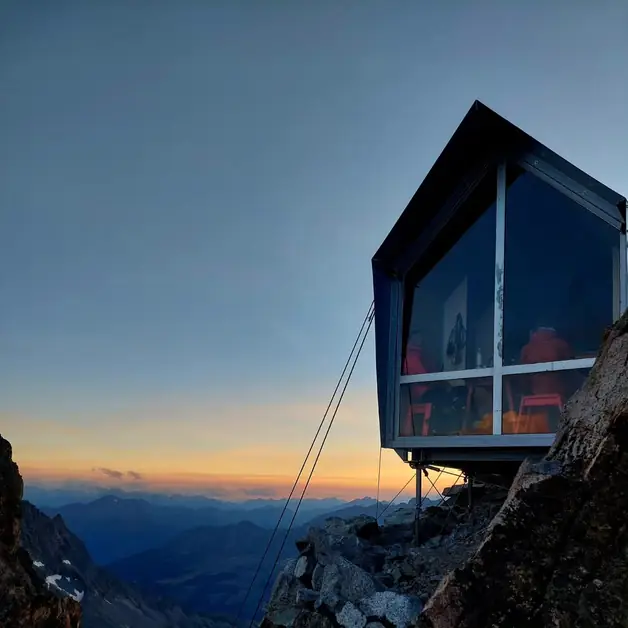
Building it was an incredible challenge. Creating a structure at 3290 meters is tough. It must withstand temperatures below -20°C and winds up to 200 km/h. Every part was sized for easy transport. The whole structure is prefabricated. It's assembled in four parts to minimize helicopter flights. The bivouac is completely reversible. It rests on non-permanent foundations anchored to the rock. No concrete, all dry-mounted. If removed one day, it leaves no trace.
Its shape resembles a two-pitched hut. It has a gray aluminum cover that blends with surrounding rocks. Inside, there's space for 8 people. A living area with a table and stools. Storage for backpacks and gear. A sleeping area with two platforms and mattresses. A large panoramic window opens east. It faces Becca di Luseney, Monte Rosa, and the Matterhorn. Waking up there must be incredible.
From the bivouac, the view spans Mont Vélan, Grand Combin, the Matterhorn, the Rosa and Bianco groups, the Valais, and all southern Aosta Valley mountains. Few have the privilege to see this. It's due to the isolation and access difficulty.
The Morion crest's climbing history is fascinating. It was explored between the 19th and 20th centuries by English and Valdostan climbers. The Central Morion was conquered on August 18, 1891. Fredrick Baker-Gabb did it with guides Clemens and Zurbriggen. The first full traverse was in September 1943 by Alessandro Miotti and Toni Gobbi. The first full winter traverse was in March 2012.
What fascinates me is the idea of such an essential place. Built with generosity and determination by volunteers. They overcame huge difficulties. It's not a luxury refuge. It's a protective shell in the middle of nowhere. It's meant for those who truly want to test themselves.
I know the road is long. I need serious training. Maybe take lessons with an alpine guide. Learn techniques I don't know. But the idea of reaching up there, opening that door, and looking out that window drives me to try. Even if my wife, when she finds out, probably won't be thrilled.