Discover the Jewish Quarter of Oria
Discover the ancient Jewish quarter of Oria, a place rich in history and beauty that tells the story of one of the oldest Jewish communities in Europe.
I stayed at a B&B in Brindisi for a few days. I rented a car at the airport with a clear plan: explore interesting nearby places. In Puglia, distances are short. You can drive less than an hour and find very different cities. From Brindisi, for example, you can reach Oria in under thirty minutes by car. Once there, parking is easy. The town isn't very busy, and free spots are near the historic center.
Oria was one of the places I wanted to see. The idea came after visiting the synagogue in Trani a few days before. I was intrigued by the history of Jewish presence in Puglia. I wanted to see how it remained visible in other cities. Oria seemed interesting because it wasn't just one building. There was an entire Jewish quarter still recognizable.
When you arrive in Oria, you enter the historic center through alleys. These alleys gradually lead to the oldest part of the city.
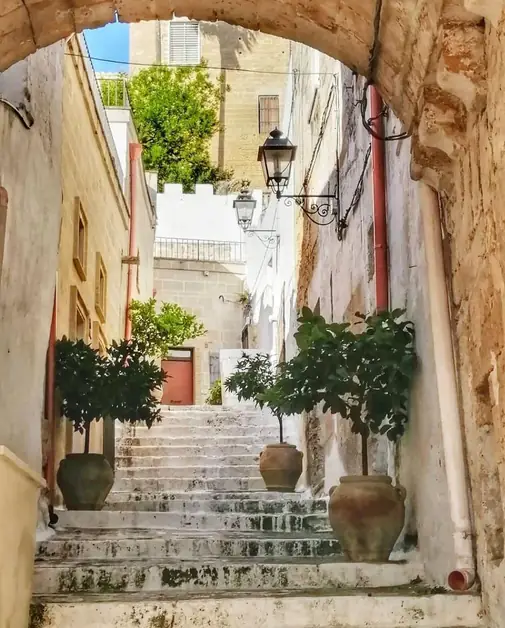
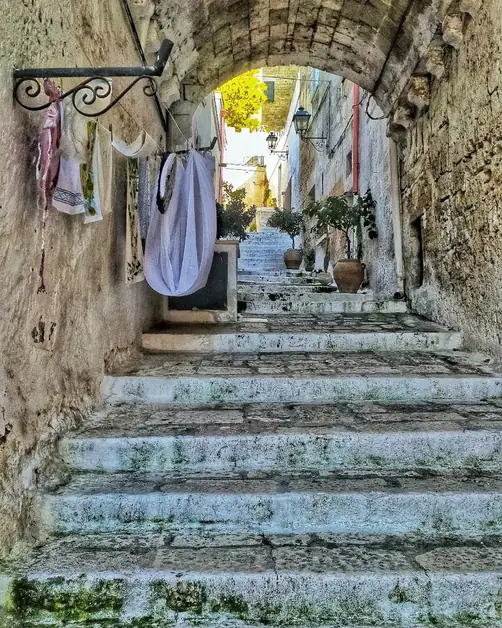
Everything is well-marked. At one point, you find the Porta degli Ebrei. It's a carefully restored baroque gate marking the entrance to the Jewish quarter. The structure is stone, and above the opening, you see worn stone blocks. They show how many centuries of passage this spot has witnessed.
Walking through it changes how you see the space. You find yourself in a maze of narrow, well-kept streets. Houses often have plants and flowers on windowsills or by the doors. This is typical of Puglia. But there's something unique: few people are around. It's not uncommon to walk for minutes without seeing anyone. Oria isn't a big tourist spot. So, there's less hustle, but you can enjoy the neighborhood calmly. It's not a monumental area in the classic sense. Yet, its simplicity and silence make it charming.
As you pass through the Porta degli Ebrei, you realize it's more than just a scenic entrance. It marks a strong historical presence. Oria's Jewish quarter, known as the Giudecca, was a lively Jewish center in southern Italy. Sources say Jewish presence here might date back to the 1st century AD, after Jerusalem's Temple destruction. But its peak was between the 9th and 11th centuries. Oria was a cultural hub in the Mediterranean then. Scholars, poets, and Talmudic teachers lived and taught here. The community faced severe damage during Saracen raids. Many centuries later, the Jewish presence ended with the 1541 expulsion.
Midway through my walk, I stopped for lunch in Oria's historic center. There were a few outdoor tables, a calm atmosphere, and surprisingly low prices compared to other Puglia spots. I thought of Trani, where I spent twice as much for a similar meal when visiting the synagogue.
If you're curious about Puglia's Jewish history, Oria is worth a stop. Here, you don't visit just one building. You explore a whole part of the city that still holds a community's memory. In Trani, you enter a specific building, a place of worship that tells the city's Jewish story. In Oria, you walk through an entire neighborhood. Two different ways to experience Puglia's Jewish presence.
To plan your day well, consider spending a few hours in Oria. Then head to Manduria, which is on the way. The two cities are close, making it easy to enjoy a cultural walk in one day from Brindisi. First, visit Oria's Jewish quarter, then Manduria's historic center. It's a simple itinerary, letting you discover two interesting Puglia spots without long travel.